Top Bar
  • About
  • Careers
  • Contact
  • About
  • Careers
  • Contact
Search Area
    • About BWSR Grants
      • Apply for BWSR Grants
      • Frequently Used Acronyms
      • Grant Information & Resources
      • Grants Quarterly Newsletter
    • Resources for Grantees
      • eLINK
      • Grants Administration Manual
      • Landscape Resiliency & Climate Change
        • Alliance to Advance Climate-Smart Agriculture
        • BWSR Climate Resiliency Toolbox
        • Carbon Sequestration: Conservation Practices and Programs
      • What’s Working for Conservation
      • Vegetation Establishment & Management
        • Native Vegetation Establishment and Enhancement Guidelines
        • Seed Mixes
        • Native Plant ID and Information
      • Restoring Conservation Lands
      • Overview
      • Programs
      • Easement Forms
      • RIM Handbook & Guidance
      • Existing Easements
      • SWCD Resources
        • Contacts
        • RIM Interactive Map
        • Geospatial Resources
        • Conservation Lands by County
        • Online Learning
        • RIM Rundown
        • Easement Alteration Policy
      • Living Landscapes Initiative
        • Lawns to Legumes: Your Yard Can BEE the Change
        • Pollinator Pathways Grants
        • Habitat Friendly Utilities Program
        • Lawns to Legumes Partner Resources
        • Habitat Enhancement Landscape Program (HELP)
        • Pollinator and Biodiversity Toolbox
          • Community Outreach
        • Managing Invasives for a Resilient Landscape
        • Minnesota Habitat Friendly Solar Program
        • Community Conservation
      • Lawns to Legumes
      • Pollinator Pathways
      • Habitat Friendly Utilities
        • What to Plant in Buffers
      • Minnesota Buffer Law
      • Buffer Establishment & Management Toolbox
      • Guide to the Buffer Compliance Process
        • Step 1: SWCD Compliance Review
        • Step 2: Landowner Notification
        • Step 3: Notice of Non-Compliance
        • Step 4: Corrective Action Notice Sent
        • Step 5: Issuing Enforcement Action
        • Step 6: Parcel is Compliant
      • Implementation Guidance
        • Average Buffer Widths
        • Buffer Measurement for a Public Drainage Ditch
        • Building Better Buffers
        • Compliance Determinations
        • Conservation Reserve Program Exemption Guidance
        • Determining Normal Water Level
        • Determining the Top or Crown of a Bank for Land Adjacent to a Public Water
        • Haying and Grazing of Buffers
        • Vegetation Establishment Goals
      • Procedures
        • Procedure 1: Compliance Determinations (Parcel and Bank Approach)
        • Procedure 2: Reporting and Progress Tracking
        • Procedure 3: MS4 Exemption
        • Procedure 4: Alternative Practices
        • Procedure 5: Other Alternative Practices Approved by the Board
        • Procedure 6: Local Water Resources Riparian Protection ("Other Watercourses")
        • Procedure 7: Failure to Implement
        • Procedure 8: Election of Jurisdiction
        • Procedure 9: BWSR's Review of County and Watershed District Buffer Rules, Ordinances and Official Controls
      • Alternative Practices
        • Alternative Practices Introduction
        • Common Alternative Practice #1: Minnesota Agricultural Water Quality Certification Program
        • Common Alternative Practice #2: NRCS Filter Strip Standard: MN 393/391 Practice Standards - Public Waters
        • Common Alternative Practice #3: Grassed Waterway/Cultivated Watercourses - Public Waters
        • Common Alternative Practice #4A: Negative Slopes or Concentrated Inflow - Public Ditches
        • Common Alternative Practice #4B: Glacial Lake Plain Areas - Public Ditches
        • Common Alternative Practice #5: Negative Slopes or Concentrated Inflow - Public Waters
        • Common Alternative Practice #6: Conservation Tillage/Cover Crops With Vegetated Filter Strip - Public Waters
        • Decision Support Tool
      • Election of Jurisdiction
      • Enforcement
      • Compliance Tracking Tool (BuffCAT)
      • Buffer Program Update
      • Contacts
      • Soils & Soil Health
        • Model Soil Loss Ordinance
        • Tillage and Erosion Survey Project
        • Soil Health Practices Grant
      • Daily Erosion Project
      • Working Lands Resources
      • Agricultural Lands
      • Forest Land
      • Peatlands
      • One Watershed, One Plan
        • One Watershed, One Plan Participating Watersheds
        • One Watershed, One Plan Policies
        • One Watershed, One Plan Resources
        • One Watershed, One Plan Videos
      • Metro Watershed Management Plan
        • Metro State Agencies Review Roster
        • Metro Update
      • Watershed District Management Plan (non-metro)
        • Amendments and Extensions
        • Development and Revision
      • Metro County Groundwater Plan
      • SWCD Comprehensive Plans
      • Planning Information
      • Working with State Agencies
        • State Agency Review Roster for County Water Plans and Watershed Management Plans
      • Water Storage & Climate Resilience
      • Groundwater Protection
      • Urban Stormwater Management
      • Prioritize, Target, and Measure Application (PTMApp)
      • Water Quality Tools & Models
      • Drainage in Minnesota
        • Understanding Minnesota Public Drainage Law
        • Other Drainage Resources
      • Minnesota Public Drainage Manual
      • Drainage Work Group
      • Drainage Management Team
      • Drainage Records Modernization
      • Chapter 103E Ditch Buffer Strip Reporting
      • Multipurpose Drainage Management
      • Wetlands Regulation in Minnesota
      • Wetland Conservation Act (WCA) Contacts
      • Joint Application Form
      • WCA Forms & Templates
      • WCA Program Guidance & Information
        • WCA Topics of the Week
      • WCA Rulemaking
        • WCA Rulemaking Comments Received
      • WCA Program Reports
      • 404 Assumption
      • Wetland Bank Credits and Fees
      • Wetland Bank Transaction Forms
      • Wetland Bank Guidance and Information
      • Local Government Road Wetland Replacement Program
      • Agricultural Wetland Bank
      • In-Lieu Fee Mitigation Program
      • Wetland Bank & Mitigation Easements
      • Wetland Delineation
      • Wetland Functional Assessment
      • Wetland Restoration
      • Minnesota Stream Quantification Tool and Debit Calculator
      • Minnesota Wetland Professional Certification Program Information
      • Wetland Training Schedule and Registration
        • MWPCP Class Portal
      • Wetland Training Resources
      • Online Learning Library & Archive
      • Training Calendar
      • Technical Training and Certification Program
        • Area Technical Training Teams
        • Conservation Planning
        • Core Competency
        • Job Approval Authority
        • Technical Training Individual Development Plan (IDP) Tool
        • Technical Training Resources
      • MN Wetland Professional Certification Program Information
      • BWSR Academy
        • 2026 BWSR Academy
        • 2025 BWSR Academy
        • 2024 BWSR Academy
      • BWSR Spring Training
      • Training Updates
      • Successful Outreach Strategies
      • Performance Review and Assistance Program (PRAP) Grants
        • PRAP Grants
        • Conservation Project Planning and Promotion
          • Inspections
        • Invasive Species Control
        • Native Vegetation
        • Pollinator Habitat
        • Prairie, Savanna, Forest and Agricultural Projects
        • Stormwater, Shoreline and Wetland Projects
      • Standard Reviews & Checklists
        • Vision for Native Vegetation and Biodiversity
        • FY25 Conservation Reserve Program State Incentives Grant Program
        • MN Wetland Restoration Guide
      • PRAP Legislative Reports
    • About BWSR
      • What We Do
      • Board
      • BWSR Executive Leadership
      • Staff
      • Strategic Plan
        • Engagement Process
      • Diversity, Equity and Inclusion
      • Affirmative Action Plan
      • Legislative Resources
      • Careers
      • Contact Us
    • About Our Partners
      • Soil and Water Conservation Districts
      • Watershed Districts
      • Watershed Management Organizations
      • Counties
      • Cities and Townships
      • Regional Partnerships
    • News & Publications
      • Subscribe
      • News Releases
      • BWSR Story Library
      • Conservation Stories
      • BWSR Snapshots
        • Snapshots Archive
      • Featured Plant
        • Featured Plant Archive
      • Reports

Search

  1. Home
  2. Search

Economics of Soil Health Systems in Minnesota

The Soil Health Institute and Cargill conducted this project to provide farmers with the economics information they need when deciding whether to adopt soil health practices and systems. The 10 farmers interviewed in Minnesota grew crops on an average of 1930 acres, using no-till on 54% and cover crops on 48% of those acres. Fifty percent of the farmers interviewed reported increased yield from using a soil health management system, and none reported a yield decline. Based on the information provided by these farmers, it cost an average of $16.38/acre less to grow corn and $23.11/acre less to grow soybean using a soil health management system. Based on standardized prices, the soil health management system increased net income for these 10 Minnesota farmers by an average of $32.13/acre for corn and $37.63/acre for soybean. One farmer who grew wheat increased net income by an average of $15.80/acre when adopting a soil health management system. The current adoption rates of no-till (6%) and cover crops (4%) in Minnesota indicate that other Minnesota farmers may improve their profitability by adopting soil health management systems. Farmers also reported additional benefits of their soil health system, such as increased resilience to extreme weather and increased access to their fields.

Subject TTCP
Advanced Tech Skills (Matrix)
Skill
Soil Health and Management
Format
Webinar
Source

Soil Health Institute, Cargill

Date
January 19, 2022
Time
35 minutes
Training Type
Online Learning
Location

United States

Notes
  • Minnesota Factsheet
  • Research Report
Related Practices & Terms

Soil Health, Economics, Minnesota Case Study

Online Location
Economics of Soil Health Systems in Minnesota

BWSR seeking public comments to inform Wetland Conservation Act rulemaking

St. Paul, Minn. –  The Minnesota Board of Water and Soil Resources (BWSR) requests public comments on potential amendments to the Chapter 8420 Rule governing the state’s Wetland Conservation Act (WCA).

Any comments submitted will be added to previous comment period input to be considered during the upcoming rulemaking process.

Proposed rules will be drafted after public comments are received. Members of the public will have another opportunity to comment after the rules are formally proposed.

Comments will be accepted until 4:30 p.m. on March 19, 2022. Written comments, questions, requests to receive a draft of the rules once they are available, and requests for more information on the rulemaking process can be directed to BWSR Wetlands Section Manager Les Lemm. Written comments can be submitted by emailing les.lemm@state.mn.us, or by mail using the address 520 Lafayette Road North, St. Paul, MN 55155.

State statute requires BWSR to adopt rules to implement the WCA, including the approval of wetland value replacement plans. The rules were originally adopted in 1993 and have been amended several times, with the current rules adopted in 2009. A primary purpose of this rulemaking process will be to reconcile the current rules with statute changes that have been made in 2011, 2012, 2015 and 2017. Information on these statute changes is available on BWSR’s website.

BWSR announces 2023 Outstanding Soil and Water Conservation District Employee

Contact: Mary Juhl; mary.juhl@state.mn.us, 612-358-5733

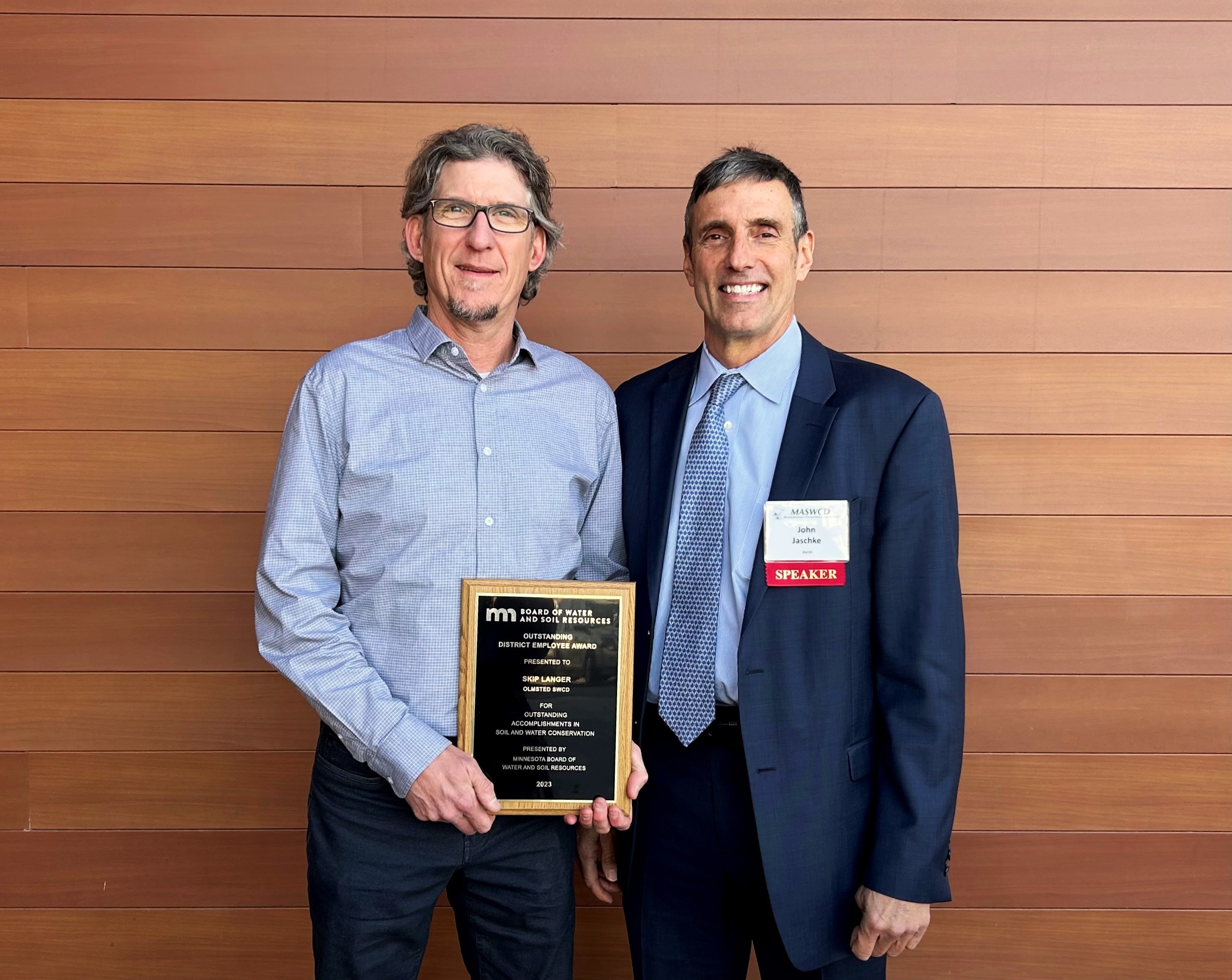
BLOOMINGTON, Minn. — Minnesota Board of Water and Soil Resources (BWSR) Executive Director John Jaschke presented the 2023 Outstanding Soil and Water Conservation District (SWCD) Employee award to Olmsted SWCD District Manager Skip Langer during the annual Minnesota Association of Soil and Water Conservation Districts’ (MASWCD) convention in Bloomington.

“It’s a privilege to recognize the accomplishments of professionals like Skip Langer, who work diligently to improve and protect water and soil resources in their districts,” Jaschke said. “The passion and commitment demonstrated by local government staff is what drives successful conservation delivery throughout Minnesota.”

Langer joined the district as a conservation technician in 1998 and was promoted to district manager in 2015. He oversees a team of seven full time employees, plus seasonal and regional staff. He was instrumental in developing a new program launched in 2022 to address groundwater protection and soil health, helping to secure $5 million in Olmsted County funding to support producers who implement best management practices such as cover crops, alternative crops and increased haying and grazing. He’s taken leadership roles in complex, multi-government projects such as the South Branch Cascade Creek restoration and development project, which restored a former 40-acre golf course to its natural habitat. Langer has also contributed to the Root River One Watershed, One Plan comprehensive watershed management planning process.

“Olmsted SWCD is a small but mighty team, and Langer promotes that culture from the top,” said Cheryl Winters, Olmsted SWCD District 3 supervisor, who nominated Langer along with the full Board of Supervisors. “His expertise and leadership are often sought after across the southeast Minnesota region, and his technical knowledge and in-depth understanding of the water quality and conservation issues strengthens the quality of our work.”

Each year, BWSR celebrates the excellent work accomplished by local government staff to advance conservation efforts across the state. An award for the 2023 Outstanding Watershed District Employee was presented to Minnehaha Creek Watershed District Director of Projects Michael Hayman on Nov. 30 during the Minnesota Watersheds’ annual conference in Alexandria.

Skip Langer
Olmsted SWCD District Manager Skip Langer (left) accepted the 2023 Outstanding SWCD Employee Award today from BWSR Executive Director John Jaschke (right) during the Minnesota Association of Soil and Water Conservation Districts (MASWCD) annual convention.

BWSR Awards $10 million in Clean Water Fund Grants

Contact: Mary Juhl; mary.juhl@state.mn.us, 612-358-5733

ST. PAUL, Minn. –  The Minnesota Board of Water and Soil Resources (BWSR) approved approximately $10 million in Clean Water Fund (CWF) grants today to improve water quality in streams, lakes and groundwater across the state. Most of the grant funding is allocated for voluntary conservation projects across Minnesota, including funding for projects that focus on improving and protecting drinking water.

“These grants will equip local governments to work in partnership with landowners across Minnesota to put projects on the ground that protect our valuable water and soil resources,” said BWSR Executive Director John Jaschke. “This locally led work is key to improving water quality and soil health in Minnesota.”

A Projects and Practices grant will support the Mustinka River rehabilitation project, which will replace the existing ditch with a 300-foot wide, 260-acre floodplain corridor with a 6.7-mile meandering channel. The project will provide approximately 34 acres of constructed wetland habitat and 226 acres of native upland buffer areas within the stream channel and associated floodplain areas, permanently protected by the Bois de Sioux Watershed District.

A Drinking Water Projects and Practices grant will help Morrison County SWCD meet its goal to reduce the risk of nitrate contamination in more than 220 vulnerable public water supply wells by planting 2,500 acres of cover crops each year for three years. Participating landowners will be given the opportunity to work with an SWCD technician to identify additional ways to improve management to reduce leaching of nitrates into groundwater.

The $10 million will fund 32 grants. Learn more about the grant recipients:

  • Projects and Practices (23 grants)
  • Drinking Water Projects and Practices (9 grants)

BWSR awards competitive CWF grants annually. The state is shifting to a Watershed-Based Implementation Funding model, which offers consistent, non-competitive funding to planning partnerships with approved watershed management plans. This helps partnerships focus on the highest priority projects within a specific watershed. Competitive CWF grants remain an important part of conservation delivery despite this shift, offering funding to individual districts for projects and practices.

About the Minnesota Clean Water Fund

Minnesota voters approved the Clean Water, Land and Legacy Amendment in 2008 to protect, enhance, and restore wetlands, prairies, forests, and fish, game, and wildlife habitat; to preserve arts and cultural heritage; to support parks and trails; and to protect, enhance, and restore lakes, rivers, streams, and groundwater. The Clean Water Fund receives 33 percent of the sales tax revenue generated by the Legacy Amendment. More information about the Clean Water Fund is available here.

Tech Talk: Annual Forages for Grazing Systems (CPS 810)

This Tech Talk provides an overview of the interim CPS 810 Annual Forages for Grazing Systems Conservation Practice Standard, Implementation Requirements, and common examples of how this practice may be used. This session also includes an overview of the technical information that has been developed for this practice, which includes Technical Note 34: Annual Forages for Grazing Systems and the Minnesota Annual Forages for Grazing Systems Design Workbook. Finally, as an interim practice, reporting on the application of this practice is required, so the Annual Forages for Grazing Systems Practice Evaluation Worksheet is discussed.

Skill
Practice Specific
Format
Webinar
Source

TTCP

Time
104 minutes
Training Type
Online Learning
Location

United States

Notes

Handouts

Related Practices & Terms

810, Annual Forages

Online Location
Tech Talk: Nov 27, 2023

History of Minnesota Forests

Duane Fogard, ABC Forester, provides an introduction to forest ecology and the history of forests in Minnesota.

Subject TTCP
Basic Tech Skills (Matrix)
Skill
Forestry Basics and Practices
Format
Webinar
Source

TTCP, ABC

Time
31 minutes
Training Type
Online Learning
Location

United States

Online Location
History of Minnesota Forests

Kernza, Multipurpose Perennial Cover

Kernza is a perennial grass that can be used as a source of grain and for livestock forage. This session covers several aspects of Kernza including conservation benefits, financial assistance options, livestock forage, seed availability, and market development. Presenters include Jake Jungers, UMN; Cynthia Bartel, Iowa State; Tessa Peters, The Land Institute; and Colin Cureton, Forever Green Initiative.

Subject TTCP
Basic Tech Skills (Matrix)
Skill
Ag & Agronomy
Format
Webinar
Source

TTCP, UMN

Time
87 minutes
Training Type
Online Learning
Location

United States

Online Location
Kernza: Multipurpose Perennial Cover

2023 Tech Talks

Tech Talks is a online training series organized by the Technical Training and Certification Program. Rotating speakers cover a wide variety of technical topics at 1:00 on Mondays. The list of Tech Talks and links to replays for 2023 can be found below.

Format
Webinar
Source

TTCP

Training Type
Online Learning
Location

United States

Notes
DateTopicDescription
January 23TTCP OnboardingThis training will provide newer employees with an orientation to the Technical Training and Certification Program. Participants will become familiar with the training resources that are available to them through TTCP. In addition, participants will start to develop their own personalized learning plan. Those who plan to attend should bring your job description to the training and ask around to find out the five most commonly used conservation practices in your work area.
February 6

Native Vegetation Guidelines and BWSR Programs: Decision Making for Successful Projects

This Tech Talk will highlight the revisions to the Native Vegetation Establishment and Enhancement Guidelines including:

  • A walk-through of the new and improved web-based format
  • Exceptions and applicability with BWSR Programs
  • Seed quality and sourcing
  • Climate change considerations
  • Seed mixes and related resources

BWSR presenters are Dan Shaw, Brad Wozney, and Suzanne Rhees.

A replay of this session can be found here.

February 27HY-8 (Culvert Design)

Join Elizabeth Oolman, NRCS H&H Engineer, discuss everything culverts.  You will learn about culvert basics, how to design a culvert using a nomograph, and how to design a culvert using HY-8.

Useful References:

  • Publications - Hydraulics - Bridges & Structures - Federal Highway Administration (dot.gov)
  • Practical Engineering's What Is a Culvert?

HY-8 Software:

  • Culvert Hydraulics - Hydraulics - Bridges & Structures - Federal Highway Administration (dot.gov)

A replay of this session can be found here.

MarchNo sessionsTech Talks were not held in March due to the four Basic Cover Crop webinars.
April 3Livestock Forage Balance Worksheet

This Tech Talk will provide an overview of the Livestock Forage Balance Sheet available in Section IV of the eFOTG under the 528 Prescribed Grazing Conservation Practice Standard. We will discuss how to develop the livestock and forage inventory portions of the forage balance worksheet.  Also, we will discuss the equations used to develop the livestock/forage balance and how to use those calculations in the field.

A replay of this session can be found here.

April 17TTCP Onboarding (Repeat)This training will provide newer employees with an orientation to the Technical Training and Certification Program. Participants will become familiar with the training resources that are available to them through TTCP. In addition, participants will start to develop their own personalized learning plan. Those who plan to attend should bring your job description to the training and ask around to find out the five most commonly used conservation practices in your work area.
May 8Economics of Soil Loss

This Tech Talk will highlight the economic and social implications of soil loss. From a farm level economic perspective, soil is an important input in agriculture production and productivity. Loss of soil is not only a concern for agriculture producers, as the movement of soil off of fields has downstream effects. In this session, participants will become familiar with the current approaches used to evaluate economic value of soil loss.  Additionally, they will become familiar with the evidence surrounding the costs and benefits of conservation practices that reduce soil loss. A better understanding of the economic values of soil loss provides insight on the role of conservation in farming practices and policy.

A replay of this session can be found here.

May 22Wildlife Habitat Planting (CPS 420)

Join Jeff Kalin, NRCS Wildlife Biologist, and Karin Jokela, Xerces Society Pollinator Planner and Partner Biologist, for a Tech Talk on the new Wildlife Habitat Planting practice (CPS 420). In this session, we will discuss:

  • The rationale for a wildlife specific conservation practice standard
  • Key differences between Wildlife Habitat Planting (420) and Conservation Cover (327)
  • Wildlife WHEGs
  • Selecting the appropriate scenario
  • Implementation requirements
  • Plant selection to support wildlife

A replay of this session can be found here.

September 25TTCP Onboarding (Repeat)This training will provide newer employees with an orientation to the Technical Training and Certification Program. Participants will become familiar with the training resources that are available to them through TTCP. In addition, participants will start to develop their own personalized learning plan. Those who plan to attend should bring your job description to the training and ask around to find out the five most commonly used conservation practices in your work area.
October 30Audubon Conservation Ranching comes to Minnesota

The Audubon Conservation Ranching (ACR) program, Audubon's flagship grassland habitat initiative, is a collaborative effort between farmers, ranchers, and Audubon to address the decline of grassland bird populations. This market-based conservation approach offers incentives for good grassland stewardship through a certification label on beef and bison products. Krysten works closely with farmers and ranchers in Minnesota that are interested in certification. In this talk she will share background on the ACR program, the pillars it was built on, and what the process for certification looks like for participating graziers.

A replay of this session can be found here.

November 13

9:00 am

Controlled Traffic Farming, Conservation Harvest Management, and Field Operations Emissions Reduction

Join Ryan Buetow, NRCS State Agronomist for a Tech Talk on the new practices Controlled Traffic Farming (CPS 334), Conservation Harvest (CPS 809), and Field Operations Emissions Reduction (CPS 376). In this session we will discuss common examples of how these practices may be used and an overview of practice requirements.

A replay of this session can be found here.

November 13

1:00 pm

Amending Soil Properties with Lime

Ryan Buetow, NRCS State Agronomist will discuss the foundation of soil management and all the impacts that pH has on crop growth, nutrient availability, and soil microbial activity. The new interim practice Amending Soil Properties with Lime (CPS 805) will be discussed along with implementation requirements, common examples of how this practice will be used, and required reporting.

A replay of this session can be found here.

November 27Annual Forages for Grazing Systems (CPS 810)

This Tech Talk will provide an overview of the interim CPS 810 Annual Forages for Grazing Systems Conservation Practice Standard, Implementation Requirements, and common examples of how this practice may be used. We will also provide an overview of the technical information that has been developed for this practice, which includes Technical Note 34: Annual Forages for Grazing Systems and the Minnesota Annual Forages for Grazing Systems Design Workbook. Finally, as an interim practice, reporting on the application of this practice is required, so we will discuss the Annual Forages for Grazing Systems Practice Evaluation Worksheet.

A replay of this session can be found here.

Pagination

  • First page « First
  • Previous page ‹ Previous
  • Page 125
  • Page 126
  • Page 127
  • Page 128
  • Current page 129
  • Page 130
  • Page 131
  • Page 132
  • Page 133
  • Next page Next ›
  • Last page Last »

Useful Links

  • BWSR Maps and Apps Gallery
  • Careers
  • eLINK
  • Staff
  • Subscribe
  • Webmaster Email

Connect with Us


Clean water land and legacy amendment program logo

BWSR's work is supported by Clean Water
Land and Legacy Amendment Funding

MN Board of Water and Soil (known as BWSR) logo

BWSR agency programs that assist landowners and local government have resulted in less sediment and nutrients entering our lakes, rivers, and streams; more fish and wildlife habitat; and the drastic slowing of wetland losses.

The Board of Water and Soil Resources is an equal opportunity employer.

Main Address:
520 Lafayette Road North
St Paul, MN. 55155
Phone: 651-296-3767
TTY: 800-627-3529
Email: info.BWSR@state.mn.us

BWSR Office Locations


© Copyright 2026 Minnesota Board of Water and Soil Resources

Accessibility   |   Affirmative Action Plan   |   Download Adobe Acrobat Reader   |   Sitemap