
What's Working for Conservation
Oak Savanna Restoration
2025 Information

The following information summarizes successful oak savanna restoration efforts at the City of Burnsville in areas where buckthorn and other woody vegetation have invaded. Key project goals include restoring ecosystem function and resiliency, oak regeneration, incorporating prescribed fire, diverse groundcover establishment, and improved wildlife habitat.
Prior to major project initiation
Girdle or drill/treat unwanted mature quaking aspen at least one or two growing seasons prior to large-scale harvest
Year 1
Conduct tree harvest planning; identify highest priority tree communities, prairie openings, favorable slopes, pockets of diversity, and public perception concerns.
Winter -Conduct forestry mow/invasive shrub removal and tree thinning under frozen ground conditions.
Spring - Seed invasive cover grass seed mix and cover crop
Spring – Garlic mustard control
Summer – Invasive forb control (thistle, crown vetch, etc.)
Fall – Buckthorn foliar spray
Year 2 –
Spring – Garlic mustard control
Spring – Buckthorn foliar spray [If impact to native forbs can be minimized]
Summer - Invasive forb control (thistle, crown vetch, etc.)
Summer – Spot mow/brush areas with unwanted native woody saplings (aspen, ash, box elder) to prevent suppression of grass mix
Fall - Buckthorn foliar spray
Fall – Controlled burn
Fall/Winter – Interseeding of forbs/sedges
Year 3 –
Spring – Garlic mustard control
Mow/Spot mow areas of dense grasses to aid establishment of forbs.
Summer - Invasive forb control (thistle, crown vetch, etc.)
Year 4
Spring – Garlic mustard control
Summer - Mow/spot mow areas of dense grasses to aid establishment of forbs.
Summer - Invasive forb control (thistle, crown vetch, etc)
Fall – Controlled burn (could be done spring of following year)
Ongoing
Burn after every two growing seasons for at least the first 10-12 years.
Continue control of invasive forbs
Spot brushing may be needed in areas where burns don’t keep pace with woody growth.
Following burns, conduct a post-burn buckthorn foliar spray (late May-mid June time period) targeting re-sprouting buckthorn.
Interseed native species whenever feasible.
Potential challenges include:
- Inconsistent kills on buckthorn saplings with fall sprays
- Issues with aspen suckering.
- Low forb diversity which was expected. We’ve tweaked rates on the grass mix on our last project which I think helped forb establishment but resulted in less woody suppression and a patchy first burn due to reduced thatch development.
Benefits seen include:
- Site burns well, allows for reset to continue ongoing woody management
- Retained some substantial amounts of remnant forbs, like rue anemone and Canada mayflower.
- Method fits well into a Phase I and Phase II grant application
- Allows for quick establishment of a vegetative community that the public can recognize as a “savanna”, aiding public support.
We are currently doing a project at a different park using two years of full site prep treatment (killing all understory vegetation with growing season herbicide applications instead of more selectively timed fall buckthorn sprays) prior to seeding the full grass/forb mix. This method will kill more existing natives but should reduce long term maintenance costs or grass dominance issues. So, we wouldn’t necessarily use this method on all future projects but I’d definitely consider it, especially on steeper slopes, areas with high public perception concerns or areas with remnant native concerns where aggressive growing season prep treatments may not be feasible. In the future, I would look for an opportunity to incorporate at least one buckthorn spray conducted during the growing season within the first two years to reduce issues with inconsistent fall spray results. (Caleb Ashling, City of Burnsville)
2025 Information
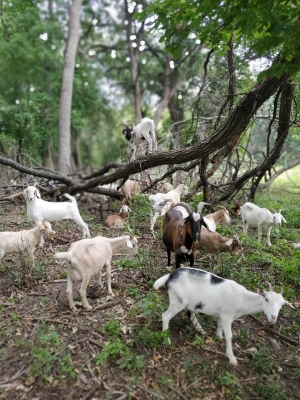
The following information summarizes recommendations for goat grazing with an emphasis on savannas and was developed by the state Restoration Evaluation Program Panel that reviews state funded project.
Goat Guidance for Project Managers
- Establish a phased, sequential approach in site restoration plans that strategically incorporates goats
- Create a sound rotational grazing plan indicating goat breed, age and numbers, operator requirements for paddock size/location, grazing days, rest periods, fencing, as well as quantifiable measures for modifying browse intensity
- Identify potential impacts to non-target species and sensitive sites, erosion etc. and establish thresholds for modifying
- Monitor frequently to guide adaptive management of herd size, timing and frequency
- Create metrics and triggers to guide decision making e.g. % site denuded of vegetation triggers moving off paddock
- Establish clear direction for operators and flexibility in contracts to allow for adaptive management e.g. increase/decrease number of goats based on performance
- Use herds that are effective at managing target species
- Goat herd operators can encourage goats to focus on target species e.g. buckthorn, sumac, by introducing these prior to prior to arriving on site
- Include sheep as needed to target ground level species
- Seeding with early successional native cool-season species may be needed to create competition for invasives and fuel for prescribed fire. Prescribed fire is typically an important follow-up management strategy.