BWSR Awards Water Storage Grants
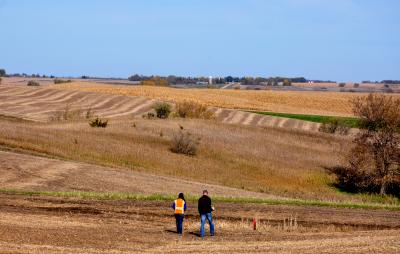
St. Paul, Minn. — The Minnesota Board of Water and Soil Resources (BWSR) is awarding approximately $1 million in grant funding to two local governments for water storage grants to improve water quality and to help make landscapes more resilient to severe weather events due to climate change. The Bois de Sioux Watershed District will receive one grant and Area II Minnesota River Basin Projects, Inc. will receive two grants. Associated work is slated to include a road crossing replacement to store more water upstream, a grade stabilization structure, flood retention improvements and other enhancements.
“Projects funded by the latest round of water storage grants will help reduce flooding and improve water quality by decreasing erosion downstream,” BWSR Executive Director John Jaschke said. “Increasing water storage capacity offers benefits to both Minnesota farmers and communities.”
The state is experiencing more frequent and intense rainfall events, resulting in negative impacts to agriculture and infrastructure, significant erosion along riverbanks, and declining water quality. The state Legislature passed bipartisan legislation in 2021 allocating $2 million to BWSR to develop a water storage program to address these challenges. An additional $17 million was appropriated from the General Fund to support the program during this year’s legislative session.
More information about BWSR’s water storage program can be found here. Learn more about the state’s climate work by visiting climate.state.mn.us
BWSR Accepting Applications for Clean Water Fund Grants
St. Paul, Minn. — The Minnesota Board of Water and Soil Resources (BWSR) is now seeking applications for its Clean Water Fund Competitive Grants Program. More than $8.7 million in grants and $8.2 million in loans are available to local governments. Eligible applicants include soil and water conservation districts, watershed districts, watershed management organizations, counties, joint powers boards and municipalities with approved water management plans.
“Supporting local efforts to improve water quality and protect drinking water is essential to BWSR’s mission,” said BWSR Executive Director John Jaschke. “These grants will help local governments advance meaningful conservation work throughout Minnesota.”
The application period opens June 29 and closes August 24. Grants are typically awarded during the winter following the application period. Interested applicants can find the Request for Proposals on BWSR’s website.
About the Minnesota Clean Water Fund: Minnesota voters approved the Clean Water, Land and Legacy Amendment in 2008 to protect, enhance, and restore wetlands, prairies, forests, and fish, game, and wildlife habitat; to preserve arts and cultural heritage; to support parks and trails; and to protect, enhance, and restore lakes, rivers, streams, and groundwater. The Clean Water Fund receives 33 percent of the sales tax revenue generated by the Legacy Amendment. More information about the Clean Water Fund is available here.
Practical Conservation Tillage for Organic Cropping Systems
The National Organic Standards require certified organic producers to implement tillage and cultivation practices that “maintain or improve the physical, chemical, and biological condition of soil and minimize soil erosion.” While continuous no-till may be impractical for organic production of annual vegetable or field crops, innovative farmers and researchers have developed many tools and strategies to reduce tillage intensity and to minimize the adverse soil impacts of field operations in organic systems. This webinar will include farmer stories featuring several of these innovations, and research documenting practical reduced-tillage strategies that protect soil health while sustaining satisfactory organic crop yields. Presenter: Mark Schonbeck, Research Associate with the Organic Farming Research Foundation (Santa Cruz, CA)
USDA NRCS Science and Technology
United States