Top Bar
  • About
  • Careers
  • Contact
  • About
  • Careers
  • Contact
Search Area
    • About BWSR Grants
      • Apply for BWSR Grants
      • Frequently Used Acronyms
      • Grant Information & Resources
      • Grants Quarterly Newsletter
    • Resources for Grantees
      • eLINK
      • Grants Administration Manual
      • Landscape Resiliency & Climate Change
        • Alliance to Advance Climate-Smart Agriculture
        • BWSR Climate Resiliency Toolbox
        • Carbon Sequestration: Conservation Practices and Programs
      • What’s Working for Conservation
      • Vegetation Establishment & Management
        • Native Vegetation and Biodiversity Collaborative
        • Native Vegetation Establishment and Enhancement Guidelines
        • Seed Mixes
        • Native Plant ID and Information
      • Restoring Conservation Lands
      • Overview
      • Programs
      • Easement Forms
      • RIM Handbook & Guidance
      • Existing Easements
      • SWCD Resources
        • Contacts
        • RIM Interactive Map
        • Geospatial Resources
        • Conservation Lands by County
        • Online Learning
        • RIM Rundown
        • Easement Alteration Policy
      • Living Landscapes Initiative
        • Lawns to Legumes: Your Yard Can BEE the Change
        • Pollinator Pathways Grants
        • Habitat Friendly Utilities Program
        • Habitat Enhancement Landscape Program (HELP)
        • Pollinator and Biodiversity Toolbox
          • Community Outreach
        • Managing Invasives for a Resilient Landscape
        • Minnesota Habitat Friendly Solar Program
        • Community Conservation
      • Lawns to Legumes
      • Pollinator Pathways
      • Habitat Friendly Utilities
        • What to Plant in Buffers
      • Minnesota Buffer Law
      • Buffer Establishment & Management Toolbox
      • Guide to the Buffer Compliance Process
        • Step 1: SWCD Compliance Review
        • Step 2: Landowner Notification
        • Step 3: Notice of Non-Compliance
        • Step 4: Corrective Action Notice Sent
        • Step 5: Issuing Enforcement Action
        • Step 6: Parcel is Compliant
      • Implementation Guidance
        • Average Buffer Widths
        • Buffer Measurement for a Public Drainage Ditch
        • Building Better Buffers
        • Compliance Determinations
        • Conservation Reserve Program Exemption Guidance
        • Determining Normal Water Level
        • Determining the Top or Crown of a Bank for Land Adjacent to a Public Water
        • Haying and Grazing of Buffers
        • Vegetation Establishment Goals
      • Procedures
        • Procedure 1: Compliance Determinations (Parcel and Bank Approach)
        • Procedure 2: Reporting and Progress Tracking
        • Procedure 3: MS4 Exemption
        • Procedure 4: Alternative Practices
        • Procedure 5: Other Alternative Practices Approved by the Board
        • Procedure 6: Local Water Resources Riparian Protection ("Other Watercourses")
        • Procedure 7: Failure to Implement
        • Procedure 8: Election of Jurisdiction
        • Procedure 9: BWSR's Review of County and Watershed District Buffer Rules, Ordinances and Official Controls
      • Alternative Practices
        • Alternative Practices Introduction
        • Common Alternative Practice #1: Minnesota Agricultural Water Quality Certification Program
        • Common Alternative Practice #2: NRCS Filter Strip Standard: MN 393/391 Practice Standards - Public Waters
        • Common Alternative Practice #3: Grassed Waterway/Cultivated Watercourses - Public Waters
        • Common Alternative Practice #4A: Negative Slopes or Concentrated Inflow - Public Ditches
        • Common Alternative Practice #4B: Glacial Lake Plain Areas - Public Ditches
        • Common Alternative Practice #5: Negative Slopes or Concentrated Inflow - Public Waters
        • Common Alternative Practice #6: Conservation Tillage/Cover Crops With Vegetated Filter Strip - Public Waters
        • Decision Support Tool
      • Election of Jurisdiction
      • Enforcement
      • Compliance Tracking Tool (BuffCAT)
      • Buffer Program Update
      • Contacts
      • Soils & Soil Health
        • Model Soil Loss Ordinance
        • Tillage and Erosion Survey Project
        • Soil Health Practices Grant
      • Daily Erosion Project
      • Working Lands Resources
      • Agricultural Lands
      • Forest Land
      • Peatlands
      • One Watershed, One Plan
        • One Watershed, One Plan Participating Watersheds
        • One Watershed, One Plan Policies
        • One Watershed, One Plan Resources
        • One Watershed, One Plan Videos
      • Metro Watershed Management Plan
        • Metro State Agencies Review Roster
        • Metro Update
      • Watershed District Management Plan (non-metro)
        • Amendments and Extensions
        • Development and Revision
      • Metro County Groundwater Plan
      • SWCD Comprehensive Plans
      • Planning Information
      • Working with State Agencies
        • State Agency Review Roster for County Water Plans and Watershed Management Plans
      • Water Storage & Climate Resilience
      • Groundwater Protection
      • Urban Stormwater Management
      • Prioritize, Target, and Measure Application (PTMApp)
      • Water Quality Tools & Models
      • Drainage in Minnesota
        • Understanding Minnesota Public Drainage Law
        • Other Drainage Resources
      • Minnesota Public Drainage Manual
      • Drainage Work Group
      • Drainage Management Team
      • Drainage Records Modernization
      • Chapter 103E Ditch Buffer Strip Reporting
      • Multipurpose Drainage Management
      • Wetlands Regulation in Minnesota
      • Wetland Conservation Act (WCA) Contacts
      • Joint Application Form
      • WCA Forms & Templates
      • WCA Program Guidance & Information
        • WCA Topics of the Week
      • WCA Rulemaking
        • WCA Rulemaking Comments Received
      • WCA Program Reports
      • 404 Assumption
      • Wetland Bank Credits and Fees
      • Wetland Bank Transaction Forms
      • Wetland Bank Guidance and Information
      • Local Government Road Wetland Replacement Program
      • Agricultural Wetland Bank
      • In-Lieu Fee Mitigation Program
      • Wetland Bank & Mitigation Easements
      • Wetland Delineation
      • Wetland Functional Assessment
      • MN Wetland Restoration Guide
      • Minnesota Stream Quantification Tool and Debit Calculator
      • Minnesota Wetland Professional Certification Program Information
      • Wetland Training Schedule and Registration
        • MWPCP Class Portal
      • Wetland Training Resources
      • Online Learning Library & Archive
      • Training Calendar
      • Technical Training and Certification Program
        • Area Technical Training Teams
        • Conservation Planning
        • Core Competency
        • Job Approval Authority
        • Technical Training Individual Development Plan (IDP) Tool
        • Technical Training Resources
      • MN Wetland Professional Certification Program Information
      • BWSR Academy
        • 2026 BWSR Academy
        • 2025 BWSR Academy
        • 2024 BWSR Academy
      • BWSR Spring Training
      • Training Updates
      • Successful Outreach Strategies
      • Performance Review and Assistance Program (PRAP) Grants
        • PRAP Grants
        • Conservation Project Planning and Promotion
          • Inspections
        • Invasive Species Control
        • Native Vegetation
        • Pollinator Habitat
        • Prairie, Savanna, Forest and Agricultural Projects
        • Stormwater, Shoreline and Wetland Projects
      • Standard Reviews & Checklists
        • FY25 Conservation Reserve Program State Incentives Grant Program
      • PRAP Legislative Reports
    • About BWSR
      • What We Do
      • Board
      • BWSR Executive Leadership
      • Staff
      • Strategic Plan
        • Engagement Process
      • Diversity, Equity and Inclusion
      • Affirmative Action Plan
      • Legislative Resources
      • Careers
      • Contact Us
    • About Our Partners
      • Soil and Water Conservation Districts
      • Watershed Districts
      • Watershed Management Organizations
      • Counties
      • Cities and Townships
      • Regional Partnerships
    • News & Publications
      • Subscribe
      • News Releases
      • BWSR Story Library
      • Conservation Stories
      • BWSR Snapshots
        • Snapshots Archive
      • Featured Plant
        • Featured Plant Archive
      • Reports

Search

  1. Home
  2. Search

Crow Wing SWCD's Barrick is 2016 Outstanding District Employee of the Year

Contact: Celi Haga

651-315-5082


St. Paul, Minn., -  The Minnesota Board of Water and Soil Resources (BWSR) is pleased to announce that Melissa Barrick, District Manager for the Crow Wing Soil and Water Conservation District (SWCD) has been honored as the 2016 Outstanding District Employee of the Year. 

Melissa has worked for the Crow Wing SWCD since 2008, when she joined the district as its water planner.  In 2011 she became the district manager.  During her time at the district, Melissa has become a leader in the Crow Wing and Pine River Watersheds, excelling in community engagement and collaborative efforts to enhance and restore the area’s vital water resources.

One of Melissa’s most recent accomplishments is securing $1.2 million in Clean Water Funds for the Serpent Lake Targeted Watershed Project.  This complex, multi-faced project is a high priority in the local water plan and Melissa has brought together numerous city officials, citizens, contractors, lake association members, and other local public and private partners to build support for the work.  As part of this project, Melissa worked to steer the cities of Crosby and Deerwood and the Irondale Township to adopt stormwater ordinances for future development and redevelopment based on Minimal Impact Design Standards (MIDS).

Other accomplishments this year included the construction of a stormwater pond, infiltration basin, and an alum treatment to remove high concentrations of phosphorous from Cranberry Lake. Melissa also garnered grant funding for a project on Big Trout Lake, the only lake in Crow Wing County that supports lake trout.

Melissa’s management style, skills, and communication were critical to the successful implementation of these projects.  She works to continually improve Crow Wing SWCD’s capacity for environmental conservation, and has built a team of resource professionals committed to making a difference for the community. She has demonstrated vision and is proactive in searching out ways to make the organization more efficient and effective.

“Melissa is a proactive leader who knows how to engage her community in support of the conservation mission,” BWSR Executive Director John Jaschke said. “Her ability to think outside the box and create these partnerships has resulted in a diversified program that meet the needs of Crow Wing County and the surrounding region.”

The Outstanding Soil and Water Conservation District Employee of the Year is awarded at the Minnesota Association of Soil and Water Conservation Districts’ convention, held annually in December.
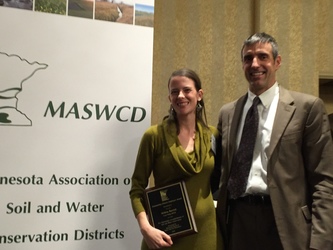
Barrick Jaschke  

BWSR Executive Director John Jaschke with Crow Wing SWCD’s Melissa Barrick, the 2016 District Employee of the Year.

It will demonstrate what we're capable of

PDF
Media File
BoisDeSioux.pdf
Video Link
https://www.youtube.com/watch?v=ydK-Bob_yRQ
County
Traverse
Major Watershed Basin
Red River of the North Basin
Story Date
Tue, 01/01/2019 - 12:00
Funding Sources
Clean Water Fund
Publication Type
Conservation Story
Show this story in the slideshow
Off

Pipestone SWCD targets nitrates

PDF
Media File
Snapshots Story 2 June 2021 Pipestone SWCD CWF.pdf
County
Pipestone
Major Watershed Basin
Missouri River Basin
Story Date
Tue, 06/01/2021 - 12:00
Funding Sources
Clean Water Fund
Publication Type
Snapshot
Show this story in the slideshow
Off

Red Lake Watershed District's Jesme named 2016 Outstanding Watershed Employee of the Year

Contact: Celi Haga

651-315-5082


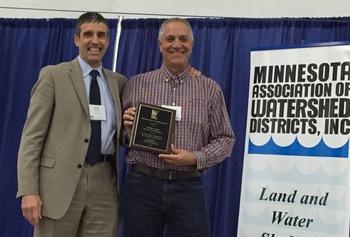
St. Paul, Minn., - The Minnesota Board of Water and Soil Resources (BWSR) is pleased to announce that Myron Jesme, District Administrator for the Red Lake Watershed District, has been honored as the 2016 Outstanding Watershed District Employee of the Year.

Myron began working for the Red Lake Watershed District in 2003, having previously worked for 20 years for what was then known as the Middle River-Snake River Watershed District.  As district administrator, Myron is the key point of contact for the largest watershed district in the state.  A leader in the region, he has successfully developed and maintained positive relationships with state and federal agencies, the Red Lake Band of Chippewa Indians, multiple local units of governments, non-governmental organizations, and the public. 

Over the years, those relationships have been key to the Watershed District’s ability to get projects on the ground.  Myron has been instrumental in the completion of multiple large-scale District projects, one of the most impressive of which was the $7.25 million restoration of the Grand Marais Creek Outlet, completed in late 2015. Conservation projects with numerous stakeholders and multiple funding sources can be difficult to manage, but Myron’s careful stewardship of the project and inclusion of multiple partners on the project team helped ensure success.

Myron has also been a true leader in the One Watershed, One Plan (1W1P) program, and has served on the Local Government Roundtable, which was foundational in the program’s development, for many years. Myron is an active member of the Red Lake River 1W1P pilot program planning work group and advisory committee.  He brought recommendations to the policy committee, worked with the watershed district board to provide financial assistance, and led the planning grant application for the Thief River watershed.

 “Myron’s work has made a positive impact on the Red Lake Watershed District and throughout the state,” BWSR Executive Director John Jaschke said. “He’s demonstrated time and time again the value of partnerships and a commitment to going the extra mile to make sure his projects succeed.”

The Outstanding Watershed District Employee of the Year is awarded at the Minnesota Association of Watershed Districts’ convention, held annually in December.

Jaschke Jesme  

BWSR Executive Director John Jaschke presented Myron Jesme with the award at the MAWD convention.

Muneeza Raza

Business Number
651-539-2526
First Name
Muneeza
Last Name
Raza
Email
muneeza.raza@state.mn.us
Division
MNIT@BWSR
Job Title
MNIT - Business Analyst
Business Street
520 Lafayette Rd N
Business City
St. Paul
Business State
Minnesota
Business Zip
55155

St. Cloud's $1.3M stormwater project affects city's drinking water supply

PDF
Media File
BentonSWCD.StCloud.2017.pdf
Video Link
https://www.youtube.com/watch?v=HyjHbJjK2bk&t=3s
County
Benton
Major Watershed Basin
Upper Mississippi River Basin
Story Date
Fri, 02/01/2019 - 12:00
Funding Sources
Clean Water Fund
Other
Publication Type
Conservation Story
Show this story in the slideshow
Off

Restoring a metro trout stream

PDF
Media File
Snapshots Story 1 June 2021 VRWJPO_0.pdf
County
Dakota
Major Watershed Basin
Lower Mississippi River Basin
Story Date
Tue, 06/01/2021 - 12:00
Funding Sources
Clean Water Fund
Outdoor Heritage Fund
Publication Type
Snapshot
Show this story in the slideshow
Off

Innovative approach to water management takes next step

Contact: Celi Haga

651-315-5082


St. Paul, Minn. - Continuing statewide work to shift local water planning to a more holistic, coordinated approach, the Minnesota Board of Water and Soil Resources (BWSR) approved seven new planning grants for the One Watershed, One Plan program.  The August 26 board action allocates up to $1,700,000 in Clean Water Fund grants to fund seven planning projects to address water quality on a watershed basis. The program aligns planning on major watershed boundaries with prioritized, targeted, and measurable watershed plans that will be developed and implemented locally.

These new planning grants follow on the heels of a successful pilot phase that involved five watersheds from around the state.  Local governments will build on existing efforts, using current local water plans, state and local knowledge, and a systematic, science-based approach to watershed management in plan development.  The resulting plans will address the largest threats to provide the greatest environmental benefits to each watershed and will involve a broad range of stakeholders, including local governments, state agencies, and community members as true partners in the planning process.

“We learned a great deal from the pilot phase,” BWSR Executive Director John Jaschke said. “Using lessons learned from those five areas, we developed program guidelines and principles that will help the rest of the state transition over the next decade to this approach.  These more efficient plans will include prioritized, targeted, and measurable implementation practices - good news for Minnesota’s waters and its citizens."


The seven planning areas are:

  • Cannon River watershed, which includes parts of Dakota, Goodhue, Le Sueur, Rice, Steele, and Waseca counties.
  • Cedar River watershed, which includes parts of Dodge, Freeborn, Mower, and Steele counties.
  • Lake of the Woods watershed, which includes parts of Lake of the Woods and Roseau counties.
  • Leech Lake River watershed, which includes parts of Beltrami, Cass, and Hubbard counties.
  • Missouri River Basin watershed, which includes parts of Jackson, Lincoln, Murray, Nobles, and Pipestone counties and all of Rock County.
  • Pomme de Terre River watershed, which includes parts of Big Stone, Douglas, Grant, Otter Tail, Stevens, and Swift counties.
  • Thief River watershed, which includes parts of Beltrami, Marshall, Pennington, and Roseau counties.


More information about the One Watershed One Plan program, including its guiding principles and plan outcomes as well as a map of the participating watersheds, can be found at BWSR’s website: www.bwsr.state.mn.us.  

Governor Mark Dayton has declared a Year of Water Action in the state of Minnesota. Governor Dayton has called on Minnesotans to examine their individual responsibility in keeping Minnesota’s water drinkable, swimmable, and fishable for generations to come.  Find out more at online at mn.gov/governor or on social media using #WaterActionMN.

Digging in: A Q&A with Lawns to Legumes gardeners

PDF
Media File
Snapshots-story-4-May-2021-L2L-QA_0.pdf
County
Statewide
Major Watershed Basin
Statewide
Story Date
Sat, 05/01/2021 - 12:00
Funding Sources
Clean Water Fund
Publication Type
Snapshot
Show this story in the slideshow
Off

Pagination

  • First page « First
  • Previous page ‹ Previous
  • Page 254
  • Page 255
  • Page 256
  • Page 257
  • Current page 258
  • Page 259
  • Page 260
  • Page 261
  • Page 262
  • Next page Next ›
  • Last page Last »

Useful Links

  • BWSR Maps and Apps Gallery
  • Careers
  • eLINK
  • Staff
  • Subscribe
  • Webmaster Email

Connect with Us


Clean water land and legacy amendment program logo

BWSR's work is supported by Clean Water
Land and Legacy Amendment Funding

MN Board of Water and Soil (known as BWSR) logo

BWSR agency programs that assist landowners and local government have resulted in less sediment and nutrients entering our lakes, rivers, and streams; more fish and wildlife habitat; and the drastic slowing of wetland losses.

The Board of Water and Soil Resources is an equal opportunity employer.

Main Address:
520 Lafayette Road North
St Paul, MN. 55155
Phone: 651-296-3767
TTY: 800-627-3529
Email: info.BWSR@state.mn.us

BWSR Office Locations


© Copyright 2026 Minnesota Board of Water and Soil Resources

Accessibility   |   Affirmative Action Plan   |   Download Adobe Acrobat Reader   |   Sitemap