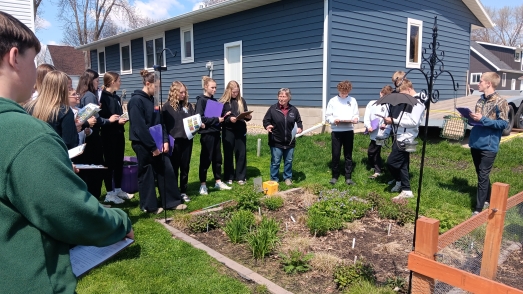
Minnesota faces significant habitat loss for pollinating insects, and meaningful progress will require participation at every level. School campuses — in both urban and rural communities — offer valuable opportunities for place-based, experiential learning that raises awareness about pollinator conservation while strengthening ecological outcomes.
Purpose: To educate future generations about the importance of biodiversity and healthy ecosystems through pollinator conservation, while empowering students to lead the installation and enhancement of diverse native pollinator habitats on public school grounds. These efforts help address the decline of pollinating insects and foster environmental stewardship through hands-on learning and habitat restoration.
This approach demonstrates that young people are not just learning about environmental challenges — they are becoming part of the solution.
BWSR’s Minnesota Living Schoolyards Program seeks to amplify the impact of the Living Landscape Initiative by engaging the next generation while advancing statewide environmental literacy and conservation goals.
- Middle school Pollinator Conservation Curriculum
The Minnesota Board of Water and Soil Resources partnered with Brown Soil and Water Conservation District to develop a 7-8 day curriculum that includes student-led installation of pollinator habitat. Below is an outline of the curriculum developed specifically for 7th grade, though the content can be adapted for other grade levels.
If you are interested in receiving a digital copy of the curriculum, requests can be emailed to Erin.Loeffler@state.mn.us.
Recommended Grade Level: 7th Grade Life Science
Program Time: 7–8 class periods of combined indoor and outdoor activities, an additional planting day if needed, and periodic maintenance of the pollinator pocket garden. Estimated using 45-minute class periods.
Driving Question: Why is biodiversity essential to a healthy ecosystem?
Program Overview
Education about native pollinators is important because of the critical role they play in food security and ecosystems. Involving science teachers through training and providing resources and support to effectively integrate pollinator conservation into curricula is a powerful way to spread awareness and inspire action among students and the broader community.
Minnesota Science Standards Alignment
7L.2.1.1.1 Analyze and interpret data to provide evidence for the effects of resource availability on organisms and populations of organisms in an ecosystem.
7L.4.1.2.2 Evaluate competing design solutions for maintaining biodiversity or ecosystem services.
7L.3.2.1.1 Construct an explanation based on evidence for how environmental and genetic factors influence the growth of organisms and/or populations.
7L.4.1.1.2 Support or refute an explanation using scientific reasoning for how animal behavior and plant structures affect successful reproduction.
7L.4.1.2.1 Construct an argument supported by empirical evidence that changes in ecosystem components affect populations.
7L.4.2.2.1 Gather multiple sources of information and communicate how Minnesota American Indian Tribes and communities and other cultures use knowledge to interpret ecosystem interactions.
Program Goal
Guide students through six steps to plan and plant a biodiverse pollinator pocket:
Learn about ecosystem services provided by pollinators.
Evaluate a seed mix of native flowers and grasses for biodiversity value.
Assess resources available at competing sites on school grounds.
Compare sites and select the best location.
Prepare and plant the selected pollinator pocket site.
Develop a maintenance plan to support biodiversity and ecosystem services.
Program Outline
Day 1
Review evidence that diverse pollinators require diverse resources.
Assess student pre-knowledge.
Introduce relationships between native pollinators and native plants.
Day 2
Examine evidence that reduced biodiversity results in fewer pollinators.
Conduct a quick outdoor biodiversity survey.
Begin data analysis correlating resource availability and butterfly abundance.
Day 3
Explore benefits of biodiversity and pollinators within ecosystems.
Complete data analysis and interpretation activities.
Introduce ecosystem services.
Day 4
Focus on creating solutions to biodiversity loss.
Evaluate native flower and grass seed mixes.
Learn to use the Minnesota Wildflowers website as an assessment tool.
Day 5
Survey available resources at potential pollinator pocket sites on school grounds.
Compare and score potential planting locations.
Day 6
Compare competing sites as a class and choose the best planting location.
Days 7–8
Prepare and plant the 10-foot by 10-foot pollinator pocket.
Assign responsibilities for planting, maintenance planning, outreach, and signage.
- Teacher Resources
BWSR Pollinator and Biodiversity Toolbox
U of M Bee Lab Pollinator Education Toolkits
Pheasants Forever Milkweed in the Classroom
Pollinator Partnership Learning Center