Updated 1/30/2026
Contents:

Submit additional questions to: cwfquestions@state.mn.us
General Information
#1. Q: Where can I find more information about requirements and permitting?
A: Below are some examples of resources you can use to learn more about requirements and permitting for specific types of projects. This information could assist in answering the project readiness RFP question.
Environmental Review requirements:
- Guidance for Practitioners
- Environment Assessment Worksheet (EAW) guidance
- Mandatory Environmental Assessment Worksheet (EAW) Categories
MPCA storm water permitting requirements:
- Construction stormwater permit overview
- Common Plan of Development
- Untreated Stormwater Runoff to Lakes, Streams, and Wetlands
DNR public waters requirements:
A: DNR Public Waters Work Permit is required to:
- construct, reconstruct, remove, abandon, transfer ownership of, or make any change in a reservoir, dam, or waterway obstruction on public waters; or
- change or diminish the course, current, or cross section of public waters, entirely or partially within the state, by any means, including filling, excavating, or placing of materials in or on the beds of public waters.
For additional resources for information about specific permits see Do I Need a Permit? on the Minnesota DNR’s website and the refer to Public Waters Work Permit process.
#2. Q: What is BWSR’s expectations for grants related to street sweeping?
A: BWSR funds should be used for targeted street sweeping that can provide more effective pollutant removal compared to existing or basic street sweeping. There have been recent advances in mapping and pollutant reduction estimate methodologies by Minnesota researchers and practitioners that help local governments create “enhanced street sweeping plans”. These plans identify critical urban areas (e.g. roads, parking lots, etc.) for street sweeping, the best times of year to conduct the sweeping, sweeping frequency, and potentially the type of equipment that will most effectively capture pollutants for priority water resources. Prior approval for equipment purchases over $10,000 is required. Grantees requesting funds to purchase a street sweeper or pay for additional sweeping should detail how the new/additional sweeping will maximize pollution reductions relative to current sweeping activities. Refer to the MN Stormwater Manual and the University of MN Water Resources Center for more information.
#3. Q: Are all feasibility studies eligible?
A: No. Feasibility studies are intended to assess viability and cost effectiveness of projects that are eligible for Projects and Practices CWF grants. Therefore, eligible feasibility studies must contain an alternatives analysis with at least one activity that is eligible for Projects and Practices CWFs. Refer to the current program requirements for eligibility.
#4. Q: Are all types of wells eligible for well sealing?
A: Not all wells but most well types are eligible for competitive grant funding. There is a small fraction of wells that must be sealed as part of state or local enforcement of State Well Code requirements and therefore would not be eligible. Use the Source Water Protection Unit Contacts and Districts map to contact MDH staff. Consultation with MDH staff is strongly advised if uncertain of the regulatory status.
#5. Q: Are incentive payments allowed?
A: No. Per the BWSR Grants Administration Manual, incentives are defined as “Monetary or other considerations that are in addition to other financial assistance provided to motivate land occupiers to install a conservation practice.” Only flat rate and percentage-based cost share are allowed under both FY27 CWF Projects and Practices Grants Programs.
Projects and Practices Grant
#1. Q: What MINNFARM pollution estimates are needed in the grant application for feedlot or livestock waste management practices?
A: For the grant application in eLINK, applicants must provide MINNFARM pollution data (index and loading numbers) by taking the difference between the pollution estimates pre- and post-project. If the project design or construction changes occur during the grant period, the new pollution reduction estimate must be reported in eLINK under Activity Details as actual results.
#2. Q: Does BWSR have any preferences for feasibility studies that are submitted for in-lake management practices?
A: Yes, BWSR prefers that feasibility studies that are assembled from multiple studies/reports include a Table of Contents that clearly indicates on what page numbers required information can be found.
#3. Q: I am applying for funding for a pit closure. Do I need to fill out the required supplemental questions for Feedlot applications?
A: It depends. Applicants do not have to complete the supplemental worksheet for facilities that are no longer actively registered, don’t have livestock, or facilities to house livestock. However, an applicant with an active feedlot registration would need to fill out the form.
#4. Q: Does the feedlot operator need to update their feedlot registration at the time of submitting the grant application?
A: The Minnesota Pollution Control Agency (MPCA) or delegated county determines feedlot registration requirements and timing. However, BWSR uses the feedlot registration information in MPCA's database at the time of grant application submittal to determine compliance with CWF program requirements.
#5. Q: Replacement, realignment or creation of bridges, trails or roads is ineligible. What about costs associated with repairing or replacing of bridges, trails or roads related to as part of an eligible activity installation?
A: Repair or replacement may be allowed as part of a project that needs to remove a road, trail, etc. Examples could include sealing a well under a sidewalk, or building an access road to a project site. Any replacement must be reasonable; not upgrades to premium materials or additional amenities.
#6. Q: Are flood damage/control projects eligible for funding?
A: The primary purpose of activities funded through this program must be to protect, enhance, and restore surface and ground water quality. Projects and Practices CWFs may be used to fund one or more components of a project for flood control, provided the primary benefit of the CWF-funded component is water quality.
#7. Q. Are all forestry management practices eligible?
A. Generally, no. To be eligible, the primary purpose/outcome of the practice must be to protect, enhance, or restore the water quality of a lake, stream, or river or protect groundwater from degradation. A water quality concern should be documented and the end goal for management should be identified before the practice or combination of practices is chosen.
Activity Eligibility - AIS; In-Lake or In-Channel Treatment
#1. Q: Is AIS programming, control, and management eligible?
A: No, except for carp and/or goldfish management that has a primary benefit of water quality.
#2. Q. Is the dredging of lake, river, or stream sediments eligible?
A: It is unlikely that these activities are eligible. Dredging activities need to have a primary purpose of protecting, enhancing, or restoring the water quality of the waterbody. The activities also need to be in an approved and locally adopted water plan (as listed in the RFP) to be eligible.
In addition, a feasibility study is required as part of the grant application for in-lake or in-channel treatment practices and needs to be approved by BWSR prior to workplan approval (see the full list of feasibility study requirements in the RFP).
#3. Q. What types of monitoring does BWSR recommend after an alum treatment is completed and the grant is closed?
A: BWSR recommends two types of monitoring. The first is to conduct routine lake sampling which includes monitoring lake water for total phosphorus, chlorophyll-a, and water clarity according to the Minnesota Pollution Control Agency’s guidance. Routine sampling should happen at least every couple of years for the effective life of the alum treatment. The second type of monitoring is to collect and analyze lake sediment cores to determine the treatment’s effectiveness in reducing the phosphorus release rate. These monitoring activities are not eligible activities for Clean Water Funds.
#4. Q: What are BWSR’s expectations for operation and maintenance (O&M) for in-lake management activities, e.g. alum treatment and carp and/or goldfish management?
A: Per the Assurances chapter of the Grants Administration Manual (GAM), BWSR requires assurances including O&M plans to ensure all installed projects and practices meet the purposes of the grant program, ensure access for regular inspections, projects will remain in place for their effective life and will provide the water quality benefits for which they were designed. BWSR may request a review of the in-lake O&M plan prior to workplan approval. In-lake treatment activity O&M plans must:
• Detail the O&M activities that are expected for the project;
• Specify how and when to accomplish all activities;
• Determine the required inspection schedule; and
• Specify contact information should questions or issues arise.
The following are O&M considerations for in-lake management activities:
Alum treatments: 1) a plan to conduct routine monitoring with procedures and schedule of in-lake water quality parameters and/or lake sediment cores to assess phosphorus release rates during the effective life of the treatment, and 2) secured funding sources/partners to cover the cost of alum reapplication (or alternative BMPs) if the original dose no longer meets proposed water quality goals/outcomes of the grant during the effective life of the treatment.
Carp and/or goldfish management activities: 1) an adopted integrated pest management (IPM) plan, carp management plan, or similar document that outlines all methodologies to achieve population and other goals (vegetative response), and also includes a schedule and procedures for conducting routine population surveys of the targeted species and projected budget, and an inspection schedule for any structures/barriers, and 2) secured funding sources/partners to cover the cost of carp and/or goldfish management to maintain the population goal or proposed water quality goals/outcomes of the grant during the effective life of the treatment.
Activity Eligibility: Subsurface Sewage Treatment Systems
#1. Q: What is BWSR’s additional expectations for funding eligible SSTS projects?
A: BWSR expects a local government to exhaust all grant funding from the MPCA prior to utilizing Clean Water Funds.
Projects and Practices Drinking Water Grant
Note: Depending on your proposed grant activities, the Projects and Practices Grant FAQs may also apply to the Drinking Water Grant.
#1. Q: Are grade stabilizations in watercourses that contribute large amounts of sediment upstream of a public surface water supply eligible projects under the Projects and Practice Drinking Water sub-grant Program?
A: No. In channel grade stabilization projects technically are not land treatment projects and would fall under “streambank stabilization and stream restoration” which would not be eligible for the Drinking Water sub-grant program.
#2. Q: Why is a map of the project area required for this program?
A: A map detailing various GIS layers is required to show why the area is targeted for drinking water protection. Data layers to consider are:
• Pollution sensitivity of near surface materials with expanded key (ex. High – coarse grain material)
• Drinking Water Supply Management Areas (DWSMAs) with vulnerability ratings with expanded key (ex. High – coarse grain material)
• Aquifer use by section
• Township testing results
• MDA Groundwater Protection Rule Level 1 and 2 DWSMAs
• Source Water Protection, Priority Area A & B.
#3. Q: Do we need ArcGIS to create the required project map?
A: No. Most data layers are available in map form using the DNR WHAF tool. Additional groundwater/drinking water information can be found here Groundwater Protection Guidance
eLINK
#1. Q: I'm getting an error when trying to validate my application.
A: Within the Add/Edit Proposed Activity screen for each activity, be sure to enter a value in response to the questions "Dollar amount request for CWP Loans" and "Dollar amount requested for AgBMP Loans." This can be "0", but cannot be left blank.

#2. Q: Can multiple photos be submitted for an application?
A: Only one application image file in one of the allowable formats may be submitted per application (jpeg, gif, tiff, bmp, png; file extension should be lower case). The application image file will be automatically scaled to fit on one page of the final application document. The composition of the application image is up to the applicant. Images are added through the “Upload Application Image” button on the Grant Request page. Images uploaded as General Attachments will not be seen by reviewers.
#3. Q: What are the character limits for application questions?
A: Most of the questions within the application have a 2,000-character limit (approximately 300 words), including spaces. If you choose to develop your responses outside of eLINK, e.g. in Word, be aware that programs may count the characters differently due to differences in how the characters are encoded.
#4. Q: The character limit for answering most application questions in eLINK is 2,000 characters. Does that include spaces?
A: Yes. A space is considered a character in eLINK.
#5. Q: Can I make changes to a submitted application during the RFP open period?
A: Yes. You will need to change the submitted status to “in process”, make changes, and change the status back to “Submit”. The status change triggers generating the report, which is added to the Attachments tab and seen by reviewers. Please note that failure to change the status back to “Submitted” will not capture any changes for review team, and applications not in “Submitted” status at the time the RFP closes will not be considered for funding.
#6. Q: Can I access my earlier grant applications even if they were not funded?
A: Yes, you can access them by logging into eLINK and navigating to "Request Funds" in the left menu, then clicking on "Funding Requests". You will need to check the “Include closed request” box to search for your previous application.
#7. Q: Can consultants submit grant applications in eLINK on behalf of LGUs?
A: Yes, there are two ways to accomplish this. One way is for the LGU to start an application and add a consultant to the “team membership”. The consultant must have an active eLINK user account to be added to the team membership. The second way is for a consultant to request an eLINK user account from the eLINK homepage and indicate the LGU(s) for which they are applying. The LGUs should be aware of this request.
eLINK user accounts should not be shared by multiple individuals; a separate user account should be requested by each individual needing access. It is not necessary to create multiple eLINK user accounts for one individual if access is needed for multiple organizations. Register here for an eLINK account
#8. Q: I have entered proposed indicators within the Application Activities. Why do I also need to provide a narrative summary of “proposed measurable outcomes”?
A: This is a required field for all applications, and allows for a high-level comparison between what was proposed during the funding request and the final outcomes reported at grant closeout. The data from this field gets reported to the Legislative Coordinating Commission. See an example of how projects funded since 2010 are tracked and reported at Tracking Minnesota’s Legacy and Trust Funds.
#9. Q: When attempting to submit my application, I get a message stating, “For each activity, you must either check the box verifying that there are no pollution reduction estimates associated with the Activity or enter proposed indicators.” What do I need to do?
A: Within the Application Budget tab, you will either need to ensure that the “Check here if this activity does not include proposed pollution reduction estimates” is checked within the Edit Application Activity” screen (pencil icon), or enter proposed indicators within the “Edit Indicators” screen (orange diamond icon). If your project will include on-the-ground practices resulting in pollution reductions, indicators must be entered.
#10. Q: When is an additional Attachment allowed?
A: Items should only be uploaded under the Attachments tab when specifically required, as per the RFP. For FY27 the following programs and/or project types require the specified attachments:
- Projects & Practices: In-Lake Treatment Feasibility Study
- Projects & Practices: Feedlot Supplemental Worksheet
- Projects & Practices Drinking Water: Project Location Map
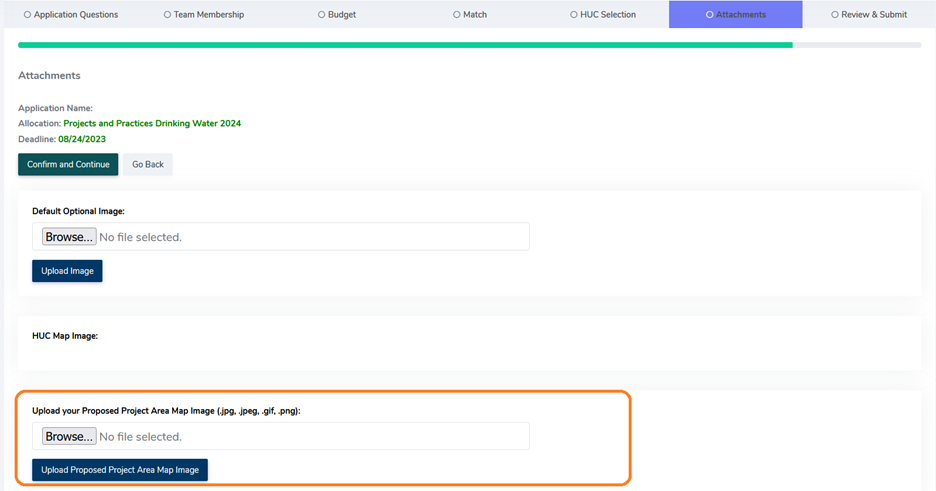
#11. Q: Where should I upload my Project Location Map?
A: Upload the Project Location Map on the Attachments page, under the prompt, "Upload your Proposed Project Area Map Image":