
Procedure is required action to be followed: Procedure is the established way of doing something; a series of actions conducted in a certain order; and/or steps necessary to meet the terms of a grant agreement.
Guidance is supporting information or recommended action: Guidance consists of recommended best practices; helpful context; and/or tools, resources and examples.
Effective Date: 07/1/2026
I. Procedure
The Minnesota Board of Water and Soil Resources (BWSR) provides state funds to grantees through a grant agreement. Within these grant agreements, there is a section on prevailing wage which states:
Contracting and Bidding Requirements
The Grantee and any subrecipients must comply with prevailing wage rules per Minnesota Statutes §§ 177.41 through 177.50, as applicable.
Minnesota’s prevailing wage laws are administered by the Department of Labor and Industry (DLI).
II. Guidance
According to DLI, prevailing wage is the minimum hourly wage employers must pay certain workers who work on construction and public works projects where state dollars are used to fund the construction. The prevailing wage includes the employer’s cost of benefits.
How it applies on BWSR grants
As stated in Minnesota Statutes, section 177.42, “project” as it relates to prevailing wage is defined as “demolition, erection, construction, alteration, improvement, restoration, remodeling, or repairing of a public building, structure, facility, land, or other public work, which includes any work suitable for and intended for use by the public, or for the public benefit, financed in whole or part by state funds. Project also includes demolition, erection, construction, alteration, improvement, restoration, remodeling, or repairing of a building, structure, facility, land, or public work when the acquisition of property, predesign, design, or demolition is financed in whole or part by state funds.”
According to DLI, conservation work occurring on private land is considered “for the public benefit”. DLI has stated that prevailing wage requirements may apply in situations in which the grantee is the direct contracting authority with a private contractor and in situations in which the grantee provides a contract to a private landowner or land occupier who in turn hires a private contractor to work on the installation of a conservation project or other construction project, as long as state funds are being used and the work completed meets the definition of a “project”.
Indicators provided by DLI that conservation work may meet the definition of a “project” may include but are not limited to:
- Earthmoving or the rearrangement of terrain;
- The work involves alteration or change in the character, nature, or use of land;
- Repurposing of the land;
- The permanence of the work performed;
- Whether the work results in land of a different nature than prior to the work, including repairing or restoring land to a purpose it is no longer fit for or returning the land to its previous, but not current, state;
- The work is not routine in nature.
According to DLI, the following are examples of typical conservation practices that would generally meet their definition of a “project”:
- Conservation Cover (when transitioning from row crops to perennial vegetative cover)
- Grade Stabilization Structure
- Streambank and Shoreline Stabilization
- Water and Sediment Control Basin
- Bioretention Basin (Rain Garden)
- Subsurface Sewage Treatment System (SSTS) Fix/Upgrade
- Well Sealing
DLI staff have clarified that some conservation work may be considered maintenance and therefore not considered a “project” if it leaves the land in its current state after the work is completed. The following conservation work may commonly constitute maintenance if the work does not result in alteration or change in the character, nature, or use of the land and is not performed in connection with other covered work:
- Seeding/vegetation enhancements;
- Landscaping;
- Pruning;
- Application of herbicide;
- Harvest, rolling, crimping, and/or tilling;
- Application of fertilizers and/or amendments;
- Mowing/harvest;
- Prescribed burning;
- Removal of invasive species.
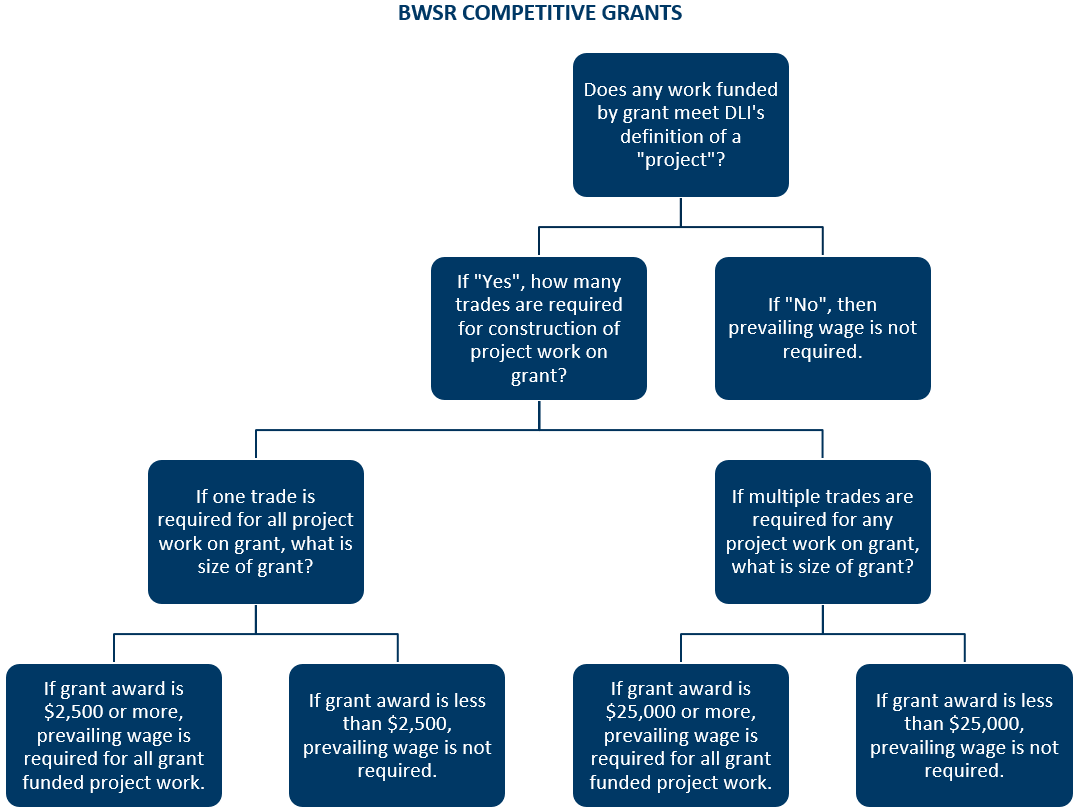
DLI staff have stated that for BWSR competitive grants, if the grant award is $2,500 or more (when only one trade or occupation is involved to complete project work) or $25,000 or more (when multiple trades or occupations are required to complete project work), and there are any activities in the grant work plan that meet the definition of a “project”, prevailing wage requirements will apply to the entire grant. Even if individual projects are completed with separate landowners/land occupiers, DLI would view the entire grant as the “project”.
Guidance from DLI indicates that if multiple labor descriptions (codes) are expected for a project, this likely means more than one trade or occupation will be involved.
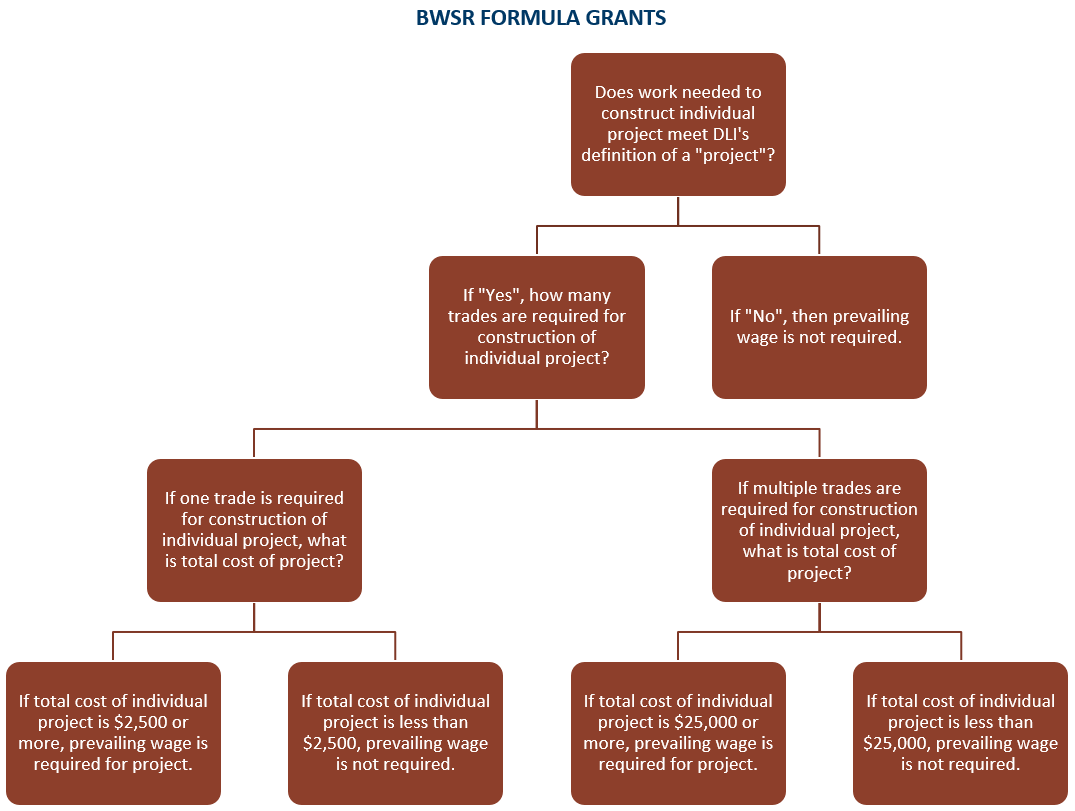
DLI staff have stated that for BWSR formula grants (including the Watershed Based Implementation Funding program), the $2,500 or $25,000 thresholds apply to cost of projects receiving grant funding on an individual basis. The dollar amount considered is the total cost of completing the work, not the amount of financial assistance provided. Unlike competitive grants, the “project” is not the entire grant but instead each project with a landowner/land occupier is looked at separately from one another.
Three scenarios given by DLI where prevailing wage would not apply include:
- If the work is being completed on Tribal projects and/or land;
- If the work is being completed by the Conservation Corps Minnesota; or
- If the work is being completed by public employees.
One of the ways DLI administers the prevailing wage law is through a complaint driven process in which DLI receives a complaint and then determines if the complaint warrants the opening of an investigation. When DLI determines that an employer has been paying less than the prevailing wage, DLI requires the employer to pay back-wages to the worker to make up the difference. DLI can also require the employer to pay penalties for failure to comply with the prevailing wage law.
A landowner and/or land occupier that is completing work themselves may be subject to prevailing wage requirements, but DLI review will occur only if there is a complaint filed asking DLI to investigate. To the extent a landowner and/or land occupier is performing work on their own project, there is likely to be considerable latitude in how their compensation is determined and reported. Grantees should ensure their organization’s valuation of in-kind match is consistent with prevailing wage rates, when applicable.
For projects receiving both state and federal funding, prevailing wage requirements of both state and federal law would apply. A contractor is required to pay the rate that is the most beneficial to the employee. Due to potential differences in some prevailing wage details (ex. rates, overtime), compliance with federal Davis-Bacon requirements does not necessarily mean state prevailing wage requirements are being met.
If questions remain and grantees are still uncertain as to whether their work meets the definition of a “project” and is subject to prevailing wage requirements, DLI recommends completing a Project Assessment Form. DLI would prefer that these forms are routed through BWSR for review before they are sent to DLI. Grantees should send the completed form to BWSR.Grants@state.mn.us.
Requirements when it applies on a project
According to DLI, when prevailing wage applies, all bid requests and requests for proposals must state that the project is subject to prevailing wage to ensure that incoming bids have factored prevailing wage rates into their submittal. DLI has also stated that all work on the project must be performed under contracts that specifically state the prevailing wage rates, prevailing hours of labor (40 hours in a week and 8 hours in a day), and hourly basic rates of pay. However, DLI has stated that specifying the wage rate category (ex. Highway and Heavy) and location of the project in the contract would be sufficient for relevant wage determination. These contacts must also include the following language:
“Pursuant to Minnesota Statutes 177.41 to 177.44 and corresponding Minnesota Rules 5200.1000 to 5200.1120, this contract is subject to the prevailing wages as established by the Minnesota Department of Labor and Industry. Specifically, all contractors and subcontractors must pay all laborers and mechanics the established prevailing wages for work performed under the contract. Failure to comply with the aforementioned may result in civil or criminal penalties.”
According to DLI, the contract for a project must also provide that the project owner must demand, and any contractor on the project must furnish, compliance documents no more than 14 days after the end of each pay period. Guidance from DLI includes that contractors and project owners must retain these records for a minimum of three years after final payments are made. Reporting forms and detailed instructions are available on DLI’s website.
Many BWSR grantees have unique responsibilities as it relates to the law and implementation of projects. Grantees often deliver grant funds through cost-share programs with landowners and/or land occupiers who are working directly with contractors to construct their project. This requires grantees to work collaboratively with landowners and/or land occupiers to clearly communicate grant-related requirements. DLI considers a contract between the landowner/land occupier and contractor that includes required prevailing wage language to be best practice. Guidance from DLI has stated that there is risk in not utilizing a contract that communicates prevailing wage requirements with a contractor as it could lead to a violation, though not all projects would carry the same degree of risk based on the complexity of the project and size of contractor(s) involved. Communicating the requirements of prevailing wage will be the best way to ensure compliance with prevailing wage laws and reduce risk to the grantee.
Determining the rates
The labor codes for purposes of prevailing wage can be found in Minnesota Rules Parts 5200.1101 and 5200.1102. DLI has developed guidance regarding appropriate labor codes for common tasks related to conservation work. If a specific job code does not exist for the work, DLI’s guidance has been to use “Common Laborer-101” or “Landscaping Laborer-103”. For most restoration and conservation projects, Highway and Heavy wage rates have historically been applied while Residential rates are typically used for SSTS fixes and well sealings. Questions on labor codes can be submitted using a Classification and Code Clarification Form that should be submitted to dli.prevwage@state.mn.us.
Questions
For any questions regarding prevailing wage laws and more information, please visit the DLI Prevailing Wage website at https://www.dli.mn.gov/prevailing-wage or contact:
Minnesota Department of Labor and Industry
Prevailing Wage
443 Lafayette Road N.
St. Paul, MN 55155
Phone: 651-284-5091
Email: dli.prevwage@state.mn.us
Grantees may also want to request assistance from their legal counsel.
Prevailing Wage Decision Trees
Description of revisions | Date |
|---|---|
Updated language | 7/1/2018 |
| Chapter eliminated and incorporated into FAQs. | 7/1/2025 |
| Chapter returned and updated based on information provided by Department of Labor and Industry. | 7/1/2026 |